
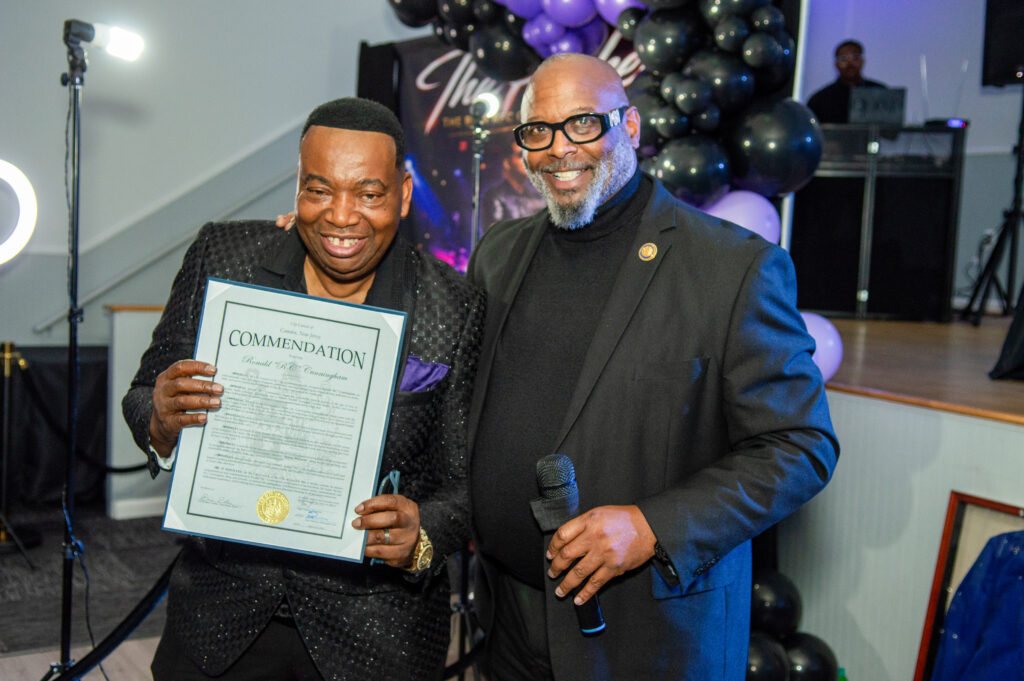
From humble beginnings in Columbia, South Carolina, to performing on some of gospel music’s biggest stages, Ron “RC” Cunningham’s journey is one of purpose, perseverance, and divine guidance. A drummer since the age of three, Cunningham developed his signature “pocket” sound through years of dedication, eventually earning opportunities to perform with legendary artists and gospel quartets, including Tommy Ellison and The Singing Stars. His career, marked by discipline, faith, and groundbreaking musical influence, has not only earned him a place in the Gospel Music Hall of Fame but also inspired his latest endeavor—his book The Pocket Life of a Drummer, which captures his story, lessons, and legacy. Beyond the music, Cunningham reflects on the importance of faith, family, and consistency, sharing powerful moments from life on the road, including a near-death experience that deepened his reliance on God.
In an exclusive interview with the nation’s premier faith-based and professional newspaper for winners, Anointed News Journal, Ron “RC” Cunningham shares his journey through music, faith, and resilience while emphasizing the power of being consistent, encouraging readers to “stay in the pocket” in every area of life.
Collins:
Who is Ron “RC” Cunningham?
Cunningham:
Well, I’m a young man who grew up in Columbia, South Carolina. At the age of three, I had drumsticks put in my hand. My father was a gospel singer, along with his brothers, so I was always in the church. Music was all around me. My brother was a drummer before me, and when he was ready to give up the drum set, he put the sticks in my hand. That’s how I became interested in drums. I’m a husband, I’m a father, and I’m a man of God.
Collins:
You recently debuted a new book called The Pocket: The Life of a Professional Drummer. What motivated you to write this book?
Cunningham:
I was around a number of people who encouraged me to write my story. They heard my story and said, “Why don’t you write it?” So, becoming interested in the idea, I began writing my story.
Collins:
Tell us a little bit about the journey. At the age of three, drumsticks were put in your hand. If I fast-forward throughout your journey, I know that you were the drummer for The Drifters and Patti LaBelle.
You also started your career as a drummer for one of the popular gospel quartets—Tommy Ellison & The Singing Stars. So talk to us about your journey. Again, at the age of three, sticks were put in your hand, and you took off.

Cunningham:
Right. Being in the church all my life, that’s where it started. After my brother put the drumsticks in my hand, I grew up playing in church.
A young man named Willie Goins gave me the opportunity to play drums outside of the church. I was used to a Pentecostal church style, where we really only had one beat, and that was fast. When I got with Willie Goins, there were two ladies in the group—a small quartet group—who showed me the ropes and taught me how to slow the beats down.
To make a long story short, I moved on to a popular church in South Carolina called Gaunter Chapel Baptist Church. That’s where I met a family—the Harpers—Margaret Harper, Deacon Melvin Harper, and their children, who were around my age. They were all very talented and already had a group together called Little Harp and the Soul Disciples.
As I joined the church, I spent time around them and I became their drummer. They were pretty popular in South Carolina. We would travel to Orangeburg, throughout South Carolina, and even into North Carolina. We were that good.
All the professional groups would come through, and in this business, it’s all about who you know. That brings me back to the Masonic Temple, where many groups used to perform—The Mighty Clouds of Joy, Slim and the Supreme Angels, The Swanee Quintet, The Williams Brothers, The Canton Spirituals, Lee Williams and the QC’s.
All of these groups would come to the temple in South Carolina. My father and his peers were Masons, so they would have us sit in the front row. I was able to watch all the drummers up close, and I studied them.
There was one drummer who really caught my eye—Pete Johnson, who played with Tommy Ellison. He was the original drummer for Tommy Ellison, and my style today is based on what he played.
Cunningham:
After playing with Little Harp and the Soul Disciples, Tommy Ellison saw me playing in a small church and gave me an opportunity. Along with Sam Williams, he asked me if I wanted to try going professional. He gave me ten cassette tapes and three weeks to learn them. He said when I was ready, he would come back and we would rehearse.
When the three weeks came, I had mastered the tapes. In rehearsal, everything they played, I was right there—pocket-wise. I had a heavy foot and a heavy hand, and I stayed in the pocket. That’s what quartet music requires. You’ve got to be strong and consistent, and I had that. From there, my journey with Tommy Ellison began, and the rest is history.
Collins:
Your book is titled The Pocket. What is the pocket?
Cunningham:
Consistent… A pocket drummer is consistent. During my journey while working on the book, I had an experience with the late James Brown. I’ll never forget it—we were in a locker room in Augusta, Georgia. He was connected with the quintet, and they held an anniversary every year on the first Sunday in October.
He came into the locker room and spoke to the groups. One thing he said that really stood out to me was that the only thing he wanted from his drummer was to stay in the pocket.
He gave examples—“Papa’s Got a Brand New Bag,” and even Michael Jackson’s “Billie Jean.” If you listen, it’s all pocket.
That moment stuck with me. Stay in the pocket—and that’s who I am.
Collins:
Your journey with Tommy Ellison and the Singing Stars, during that time, you were able to introduce a new sound in gospel music. Tell us about that experience and how it has continued even to today.
Cunningham:
Well, when I came onto the quartet scene with Tommy, I was the rookie. There were other drummers before me—Bobo, Charles Green—guys who played with The Swanee Quintet, The Mighty Clouds of Joy, and The Gospel Keynotes.
I was the rookie, so I had to earn my respect. Like I said, I had the quartet sound—the heavy hand, the heavy foot, and consistency. That’s what carried me.
The journey required me to earn my stripes. When the moments came, I did, I proved myself, but it didn’t come easy. When we performed at civic centers, you would have all these quartet groups on the program—The Mighty Clouds of Joy, The Supreme Angels, The Blind Boys, The Swanee Quintet—and those drummers were serious. You had to earn your place.
There was one particular drummer, Charles Green from the Swanee Quintet. He used to wear a sneaker on his right foot for the bass drum. When they finished playing, he would throw the sneaker to whoever was up next and say, “Give it back if you can.”
Now, you know what that means in music. Many nights, I had to hold onto that sneaker—but eventually, I reached a point where I could throw it back to him.

Collins:
You are also in the Gospel Music Hall of Fame. What is it like receiving that type of honor?
Cunningham:
Man, it was amazing. The Gospel Music Hall of Fame is down in Alabama, and there are so many legendary groups in there. I went in with Tommy Ellison and The Singing Stars.
The Live in Atlanta, Georgia recording really put me on the map. Tommy Ellison’s group was full of charisma—you couldn’t hide in it. He featured everyone: the guitar player, the man in the middle, which is Oscar Hartley, and Dennis Bowers guitar solo.
That night in Atlanta was the first time we ever did a live video recording. When Tommy called on me, I wasn’t expecting it. I just did what I do—and that’s where the drum solo was born, right there in Atlanta, Georgia.
Collins:
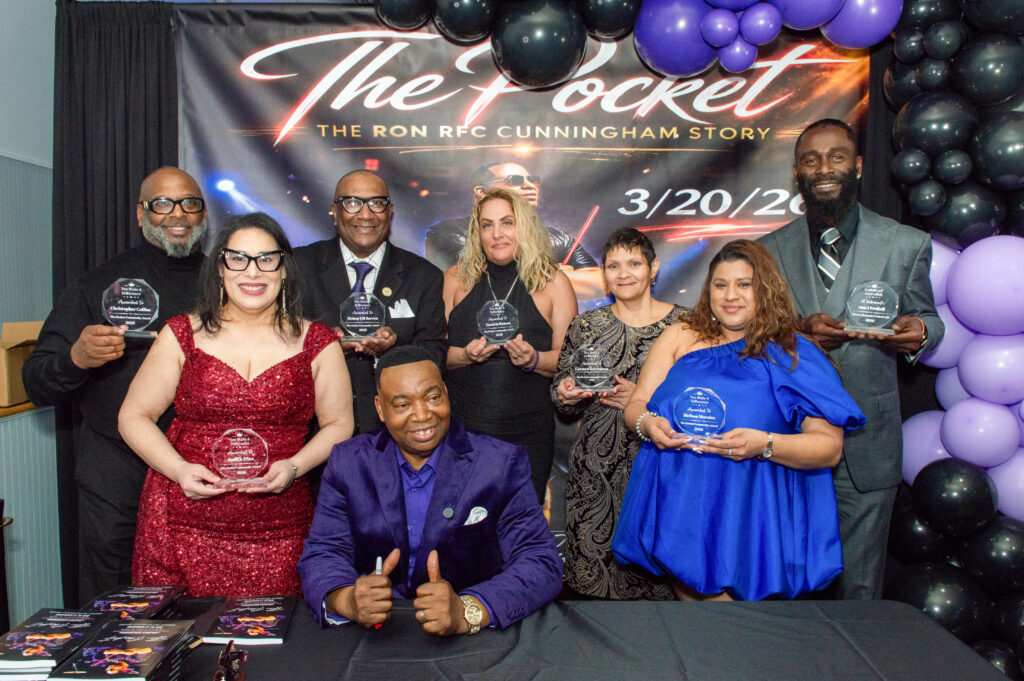
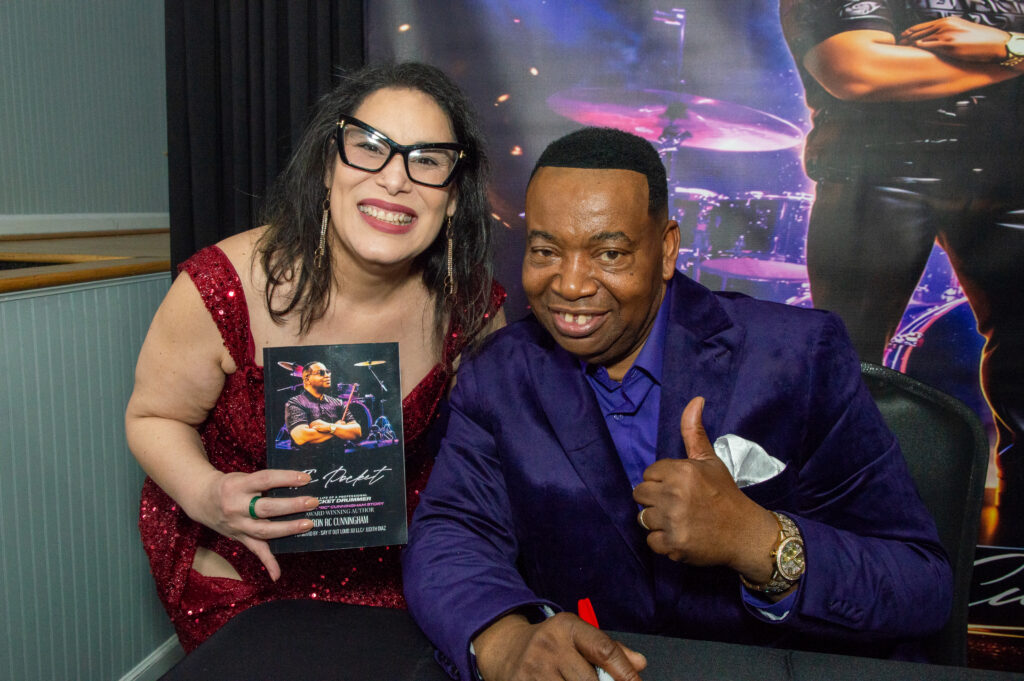
So, getting back to the book—recently, on March 20th in Glendora, New Jersey, you had your book release and signing. Tell us about that night.
Cunningham:
It was an amazing, phenomenal night. I trusted God through the entire process. My family had been dealing with different issues, including sickness, but I stayed focused and worked hard on it. We just wanted to present the story and get it out. This was my first time ever doing a book launch, and it turned out phenomenal. My guests showed up, the room was full, and the energy was incredible.
We also took time to honor members of the community who have done great work, and that was one of the highlights of the event. I was truly honored to do that.
Collins:
And during your debut, you were interviewed by two gentlemen in the media industry, where you shared part of your journey—what it was like traveling on the road.
You also talked about a particular experience in the Bahamas involving a small plane that ran into some issues. Tell us about that.
Cunningham:
It was a private airline that transported entertainers from Miami, Florida, to the Bahamas. That was their primary job.
On that particular trip, the plane held about 20 passengers. It didn’t take much to overload it. Once the equipment was loaded in the back, the plane would tilt, so they asked a few of us to move to the front to balance it out.
We made it to the Bahamas safely, but on the way back, both engines shut down mid-flight. At that moment, you don’t know what’s going to happen—you just pray.
The plane was dropping. I had my eyes open, but I couldn’t see anyone. I could hear people screaming and crying out. I began to pray. Right before the plane was about to crash, the engines came back on, and the plane stabilized. We were able to land safely. Two months later, that same plane crashed—with a major artist on board.
Collins:
And the world is familiar with that artist who lost her life in that crash.
Cunningham:
Yes.
Collins:
When you look at your journey—and all the temptations that come with being on the road as an artist—how important is it to have a God foundation?
Cunningham:
Very important, because that’s who you have to depend on to get you back and forth. The road has been marvelous to me. When I talk about the journey, I think about meeting my family. I met my wife on the road, and we have a beautiful daughter who has given us two wonderful grandchildren. All my life, all I knew was the road.
I thank God for being there, for keeping me, and for ordering my steps to where I am today—walking in the pocket, with a beautiful family. I’m also grateful to be able to tell my story so my family can have it once I’m gone.
Collins:
How can people get a copy of The Pocket?
Cunningham:
They can email us at RonCunningham777@gmail.com. The website is ThePocketCommunity.com. You can also order through Zelle at (609) 792-9127, or send via Cash App at $RonaldCunningham31 and $DrummerTalk357.
Collins:
And are you available for speaking engagements? If so, how can people contact you?
Cunningham:
Yes, they can contact me through ThePocketCommunity.com. All of that information is there.
Collins:
What’s next for RC Cunningham? We know you’re very active on social media with your podcast—you’re welcome to talk about that as well.
Cunningham:
What’s next is community. You’ll see me on social media, doing live interviews on the spot—that’s what I love to do. I’m keeping that in the pocket, because that’s what I enjoy.
You’ll also see me with the DTP Network, on site at events, doing live interviews. That’s what community means to me.
Collins:
The Anointed News Journal has over 180,000 readers biweekly. In conclusion, what would you like to say to our readers?
Cunningham:
I want to say this—keep it in the pocket. Stay consistent. No matter what you do in life, keep it in the pocket.
Conclusion:
Ron “RC” Cunningham’s journey stands as a testament to the power of faith, perseverance, and consistency, both on and off the stage. From life-changing moments on the road to influencing the sound of gospel quartet music, his story reflects a life committed to purpose, family, and staying true to his calling. As he continues to inspire through his book, speaking engagements, and community presence, his message remains clear—no matter where life takes you, always keep it in the pocket.
By Chris Collins
Your Brand Belongs with ANJ!  Learn more